

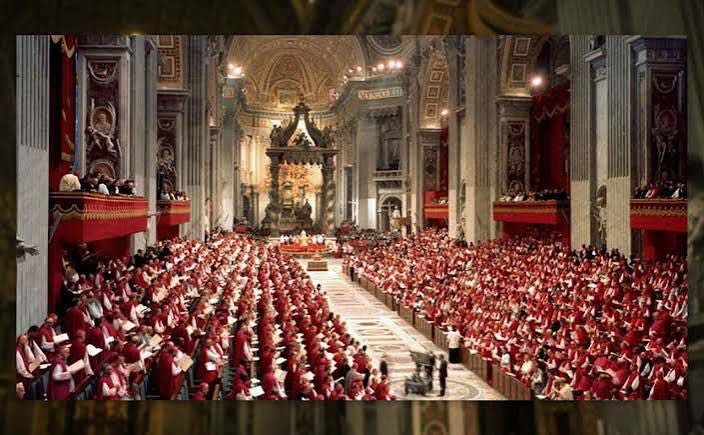
In the year 2010, a priest decided he needed to preach on something urgent to his congregation. His congregation could be classified as “rad-trad,” even by those like myself who hated the term. They were still within the diocese, but their connection to the diocese was very tenuous. They were hyper-critical of the hierarchy at every turn, even when the Bishop did everything he could to integrate trads. The priest (whose reputation with his flock was ironclad) decided he would spend the year educating his congregation on the Second Vatican Council and how to interpret it in harmony with tradition. This was very modest: five minutes every Sunday, after a brief 3-4 minute homily. He was certain this was a pressing need for the flock, and that certainty lasted not even two months. He canceled because of the criticism he got from his flock. The criticism surprised him. Everyone there accepted the Council, they just wanted people to stop talking about it.
This experience was a load-bearing event for me, and 16 years later it still informs much of what I write about. Most online discourse (including by those who are trads) is not very useful or relevant. The things we discuss online aren’t what is often discussed in the pews, even by those who we are otherwise aligned with. I’d like to try and outline why the response tends to be apathy regarding the Second Vatican Council, and not just among traditionalists.
The biggest reason for this apathy is that, sixty years later, we can’t say what Catholics have to accept regarding Vatican II. This became most prominent in the pathetic kabuki theater between Rome and the SSPX. When the subject of Vatican II came up, Rome could not define what the SSPX had to accept, and the SSPX could not define what from Vatican II they actually rejected. This exposed what smart people have known forever: Vatican II didn’t define anything, and you can’t reject that which isn’t defined. That doesn’t mean it’s not authoritative, but you can’t end any discussion with “it’s an ecumenical council.” Nobody pays attention to language, they pay attention to actions. You can say Vatican II is super important all you want, but if you cannot define one thing people have to believe regarding its teaching, you do not believe it is that important. Why should people adopt a standard you clearly don’t believe in?
A second reason for apathy is that since Vatican II cannot be defined, even popes have had different visions about its teachings. Pope Francis said in 2016 that states must be secular. This was in line with previous Vatican practice after the Council, where state religions were tied to empty pews after the 1960s. In 2026 Leo praised the city-state of Monaco for…. having Catholicism as the state religion. I suppose you could construct some lengthy exegesis on how these positions aren’t contradictory, but the simple answer is they are contradictory, but popes are allowed to be contradictory in the prudential realm. Even if commonality with Protestants is understood, it’s a simple fact conversion is emphasized more in 2026 than 1975. These changes are all defensible only because Vatican II and her reforms never actually taught otherwise, despite the discourse.
A third reason is the progression of Father Time. I have been told that my attitude towards Vatican II “undermines” a council that had been over for 17 years before I was born. The antipathy towards Vatican II comes from those whose grandparents have no real memory before Vatican II. (Your memories at age 10 or 15 don’t count.) In 2025, Bishop Erik Varden offered an insight that the wider Church has yet to ingest about what time has done to the memory of Vatican II:
The collective remembrance of what the council and its aftermath felt like has faded… Today’s young Catholics are not ungrateful for the council’s great gifts, but unable to proceed with their grandparents’ mindsets, uninclined to flog dead horses, unenthused by fossilised projects of aggiornamento when the sun has set on the giorno by which they were defined.
Today’s Catholics have no real attachment to a council which defined nothing, expects nothing, and is tied mostly to an era of chaos. They are grateful in the same way that one is grateful to the past in general: it shapes who we are today. Yet most importantly they are ready to move on. They do not think about Vatican II. They will not read its documents outside of research or a paper they may have to write. There will be sentences that inspire, every other sentence will be skipped over. In this, Vatican II will become like every other council. The generation formed by Vatican II (either pro or con) has and will continue to struggle with future generations having this apathy, and we will learn that the teacher of Ecclesiastes was right: there is truly nothing new under the sun.
Understood through this lens, most of the attempts to make people care fall short. We were often told that ecumenical councils took at least one generation to be understood. Once that passed in 2010, we are now told (a sentiment echoed by Pope Francis) that ecumenical councils take a century to work themselves out. It never dawns upon the one stating this that the argument works both ways. During that time (insert arbitrary date here), the original enthusiasm passes, and more sober assessments are conducted. As time goes on, points which were viewed as indispensable to understanding the Council become quite dispensable. Like anything else, not getting caught up in momentary exuberance allows you to look at things with the clearest eyes.
Against this backdrop, Leo XIV has decided to lead the Church once more into the breach. He is devoting his Wednesday audiences to explaining what the Council really meant. For the content creator online, it can be a goldmine. For the average Catholic, it will almost certainly be treated like every other Wednesday audience: completely ignored. If I could be so bold as to offer an alternative, it would be show, don’t tell. Stop talking about what was meant, and start talking about what was, and what is. If it was better, say it, with evidence. If it wasn’t, admit it. We could then learn from its success, its failure, or its unfinished work.
This can’t be done because nobody can say with a straight face it was a great success. On the liturgy (where Leo spent most of his time so far) he has already spoken about the sad state of liturgical affairs today, sixty years after the Council. In the popes backyard, an Italian Archbishop admitted Italy, sixty years later, still doesn’t know how to celebrate the Novus Ordo seriously.
I do not offer this as a way to harm Vatican II. I offer this as a way to allow it to take its proper place among the ecumenical councils of the Church. Until we are willing to treat it as a past event that is one of twenty-one (as opposed to an ongoing process), it cannot be embedded within the hearts of men. If we continue to treat it as the prism through which all must be understood, that continued apathy is not a prediction. It is a spoiler.
You can tell who is a "company man" by his age and the importance he places on VII. The only people younger than 50 who care are the ones looking for Diocesan jobs.
Ha! So true;
the younger the Catholic, the more V2 *real meaning* explainers get eye-rolls